
Hampden Township Previous Residents Sources
A backward address search in Hampden Township has distinct time bands. Cumberland County keeps the active land trail with the Recorder of Deeds, while the County Archives and the Cumberland County Historical Society, often called CCHS, hold different kinds of older context. The table does not turn those sources into a continuous household list. It identifies where a search can move when a recorded deed alone does not explain who lived at an address.
| Source | Years It Covers | Where Held | What It Shows |
|---|---|---|---|
| Recorder deed index | 1750-present | Landex and Recorder office | Recorded grantor/grantee transfers and document placement. |
| Mortgage index | 1973-present | Landex and Recorder office | Recorded financing documents tied to a parcel trail. |
| Miscellaneous index | 1956-present | Landex and Recorder office | Other recorded documents; the live document menu was not verified. |
| County Archives records | Generally 1750-1950 | Archives Local Listings and counter | Inactive permanent county material, with scanned availability varying by item. |
| CCHS maps, tax lists, and city directories | Exact year runs unverified | CCHS library and archives | Historical address, map, and household context when a relevant item is confirmed. |
| Federal census schedules | Released after 72 years | Federal archival access channels | A household snapshot for an enumeration year. |
Begin with the most recent parcel and then move toward older material. That order keeps a search anchored to a specific piece of land instead of joining unrelated names that happen to match an address in a later record.
Hampden Township Parcel Starting Point
The Cumberland County Property Mapper is the confirmed first stop for an address trail. Its Search Bar accepts a street number plus street name, or a parcel identification number, also called a PIN. Select the parcel to open the assessment information in the left-hand panel. Record the PIN, property details, and any displayed sales context before turning to the deed index. The mapper is a land and assessment tool, not proof of every person who lived at the address.
The county's Map Services guidance describes the same address and PIN route, parcel selection, and selected assessment information. That makes it useful for resolving which parcel the historic search concerns before names enter the process.
The Landex records-access service is the route named by the Recorder for the next stage.

The parcel notes provide the bridge from a present address to the recorded transaction trail.
Hampden Township Previous Residents Deed Reach
Cumberland County states that its deeds reach from 1750 to the present. That unusually deep recorded-land history can establish a sequence of conveyances, but it does not promise that every image, field, or search feature is equally available online. The county lists mortgages from 1973 forward and miscellaneous documents from 1956 forward. Treat those dates as category coverage, not as a claim that every document explains a household change.
The county's Recorder of Deeds page identifies Landex as the online records-access service and also confirms a Recorder counter channel. A previous residents search often needs both: the online service for an index path, then the office when a record needs review or the historical link remains unresolved.
Access detail. The Recorder announced a $0.50-per-page charge, effective August 1, 2026, only for trust documents attached to deeds when e-filed. It is not a general fee for all deed images or counter copies.
Tracing Hampden Township Previous Residents Deeds
Use the current parcel information to begin a documented chain of title. The current owner in a deed may not have lived at the address, yet the deed can still identify the transfer needed to reach an earlier owner. For each link, preserve the recording date, document reference, names, and legal description. Do not substitute a matching street address for those record details.
- Locate the present parcel in Property Mapper with the street number and street name or the PIN. Save the parcel identifiers and assessment context.
- Use the current owner's acquisition in Landex or at the Recorder counter. Search for the deed that names that person as grantee, the person receiving the property.
- Record the seller, or grantor, along with the legal description, subdivision or lot language, PIN, and recording reference from that transfer.
- Search the prior owner as a grantee to find the earlier acquisition. Repeat one conveyance at a time rather than assuming the next matching name belongs to the same land.
- At every backstep, compare the legal description, subdivision or lot, and PIN. Identical street addresses can hide changed parcel boundaries, so an address match alone is not enough.
- When the online path fails, ask the Recorder about its office access channel and then move to County Archives or CCHS material for the older contextual record.
- Grantor
- The person or entity transferring an interest in the recorded document.
- Grantee
- The person or entity receiving that interest. In a purchase deed, the buyer is generally the grantee.
- Chain of title
- A documented sequence of transfers for the same parcel, followed backward from a known transaction.
- Legal description
- The recorded land description, such as subdivision and lot language, used with a PIN to distinguish a parcel more reliably than a street address alone.
Hampden Township Previous Residents Parcel Checks
A street number is a useful starting point, not the historical identity of a parcel. The county distinguishes a situs address, which tells where land sits, from a mailing address, which directs notices and may be elsewhere. A legal description and PIN can survive changes that make the street label look familiar while the underlying parcel has been split, combined, or described differently.
For that reason, write down the subdivision name, lot or block language, and PIN at each deed transition. Compare those fields against the selected parcel and the prior recorded instrument. If a detail conflicts, pause the chain rather than folding a different parcel into the house history. The research did not verify a local street-renumbering guide, a continuous reverse-directory run, or a local Sanborn map route, so none should be assumed to repair the conflict.
Note: A recorded owner is a document role, not a complete account of a former household.
Hampden Township Archives for Past Residents
When a deed sequence reaches a dead end, Cumberland County Archives offers the governmental historical layer. Its Archives Local Listings cover county-office material dated 1750 through 1950. A listing can signal where an inactive permanent record belongs, but scanned availability varies. The county directs researchers to arrange access for material that is not scanned.
The County Archives access page places the Archives at 310 Allen Road Annex in Carlisle. Public hours are Monday from 10 a.m. to 4 p.m., or by appointment. Bring the parcel notes and the date range already established from deeds so staff can assess a focused record request.
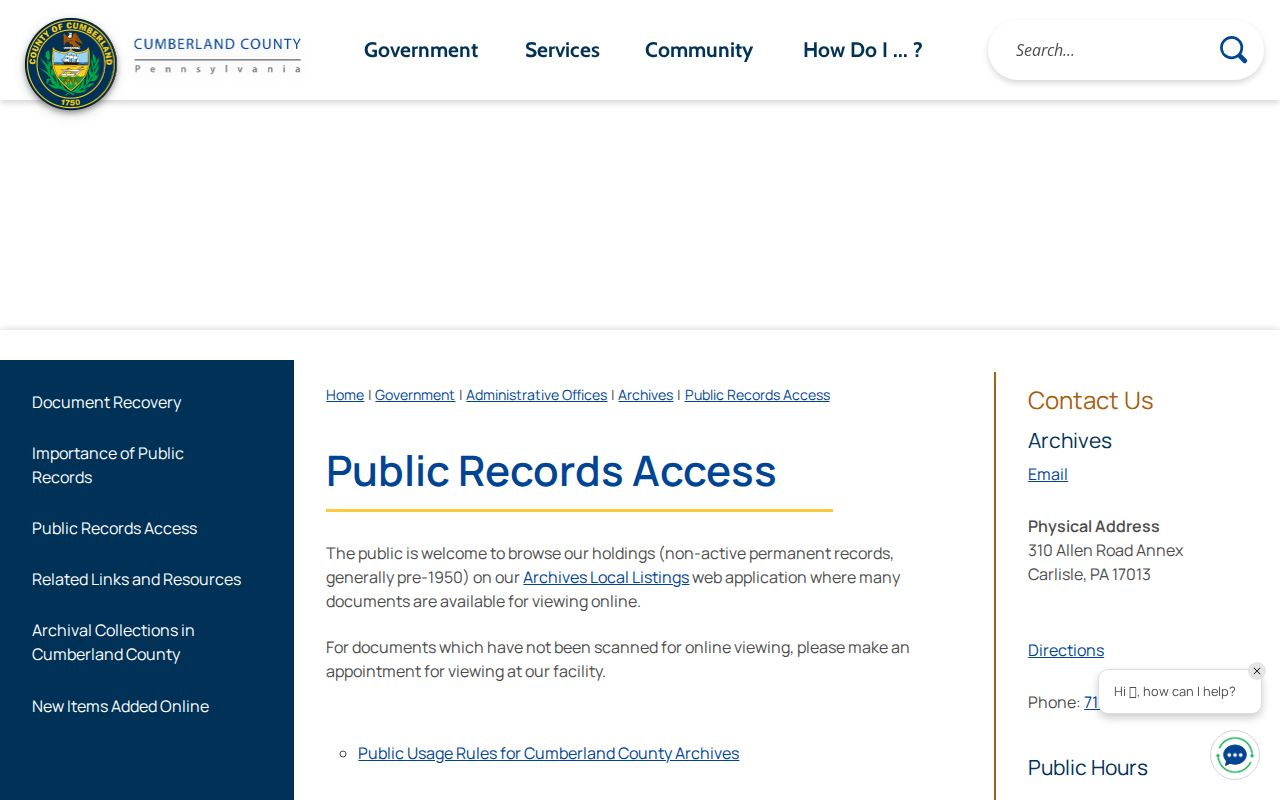
The appointment route is especially useful when an online listing identifies a likely record but does not supply a scanned image.
The Archives Local Listings database is a separate discovery channel from the Recorder's live deed system. Use it to locate older county material, then keep the deed reference in the research notes so both trails remain connected.
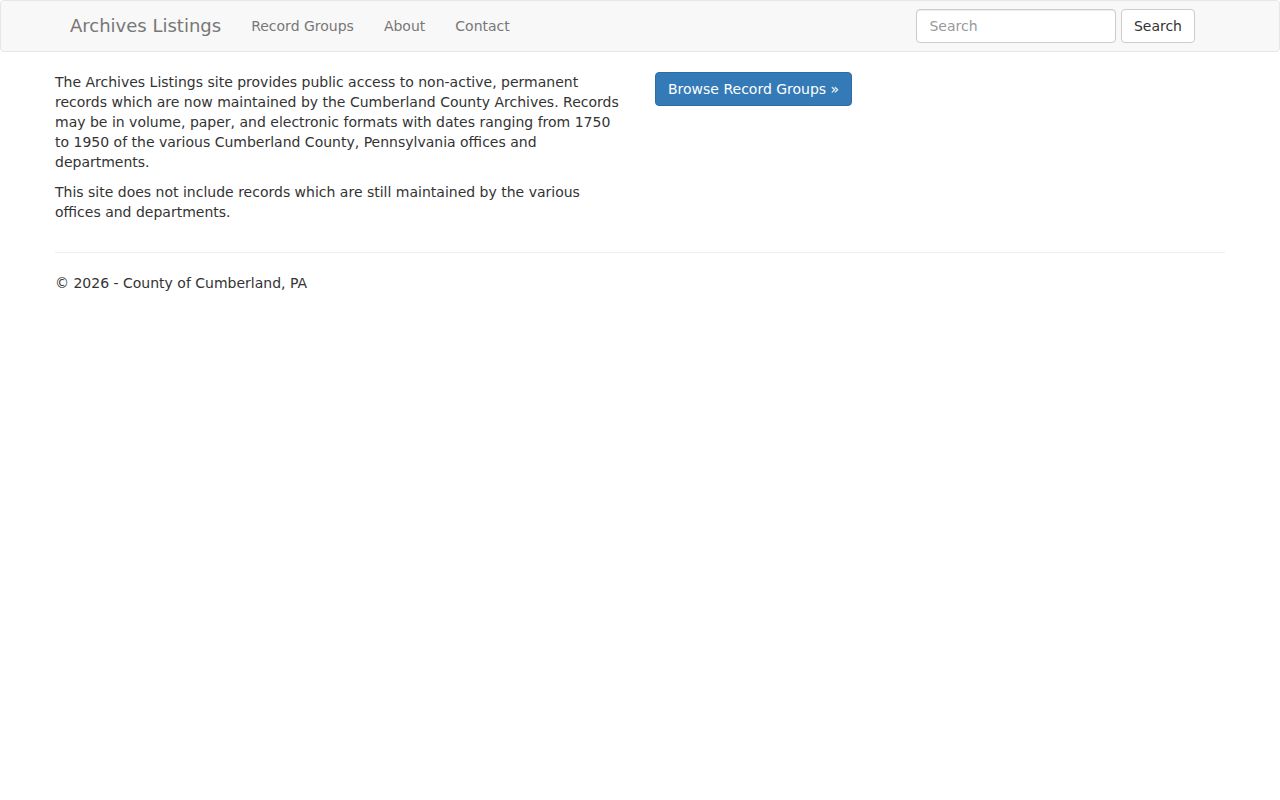
The listings identify historical holdings, while the appointment and counter process handles items that have not been digitized.
Hampden Township Directory Census Pairing
Deeds trace recorded transfers. Household sources add a different layer. Once an address period is known, ask CCHS staff whether its city directories, maps, tax lists, county records, newspapers, genealogical material, or manuscripts include the relevant place and year. Hampden residents may appear under Mechanicsburg, Camp Hill, Carlisle, a rural route, or a nearby settlement, so retain the label the source uses rather than replacing it with a modern township name.
- Use the deed chain to define a possible owner or address period.
- Request the exact directory, tax-list, or map holding from CCHS by community heading and approximate year.
- Pair any located directory date with the nearest released federal census schedule, which becomes available after 72 years.
- Check a prior and later directory volume when available to distinguish a move from an omitted entry.
- Keep the printed heading, year, call number, and address wording with the deed notes.
Historical directory collections have their own access limits and unverified year runs. The Hampden Township city directories route explains how to approach the collections without treating an unconfirmed volume as a complete roster.
Hampden Township CCHS Research Route
CCHS is a closed-stack archival library at 21 N. Pitt Street in Carlisle. Its research collection includes county histories, family histories, manuscripts, church and cemetery records, newspapers, business records, and other historical material. The first practical request is for a catalog call number or collection name, not a claim that a given address appears in a specific book. Staff or volunteers can help during open hours, and paid remote research is available when a visit is not possible.
A nonmember daily access charge is $5. CCHS members and students have no access charge, and a Cumberland County Library System card holder can use a special CCHS/CCLS pass checked out from a county library branch for no-charge Society-resource use. The Society lists $0.50 for single-side paper or microfilm copies and $5 for personal camera or phone use. Give a remote researcher name variants, an address, a period, the likely collection, and a maximum fee, then ask for citations and copy options.
The Cumberland County Historical Society research service describes the collection and its access channels.

CCHS can supply context around a deed trail, but the exact directory and map year must be confirmed from the catalog or staff response.
Hampden Township Previous Residents Boundaries
House-history research is strongest when every statement names the kind of record behind it. A deed supports a recorded transfer. An archives item can place a county record in time. A directory, tax list, census schedule, newspaper, cemetery record, or estate file may offer further context only when the actual entry is located and cited. Neither an empty index result nor a familiar address proves a complete chronology.
Older death or obituary clues can lead to estate material at the Register of Wills or to historic repositories. Cumberland's online marriage and estate access begins in 1994, while earlier open records require an in-person route. That split is another reason to preserve exact date bands and custodian names instead of assuming that one online search settles the past residents of a Hampden Township property.
Lawful use. Previous residents research in Hampden Township is appropriate for house history, family history, and personal curiosity. Do not use records to track, harass, or harm any living person.